
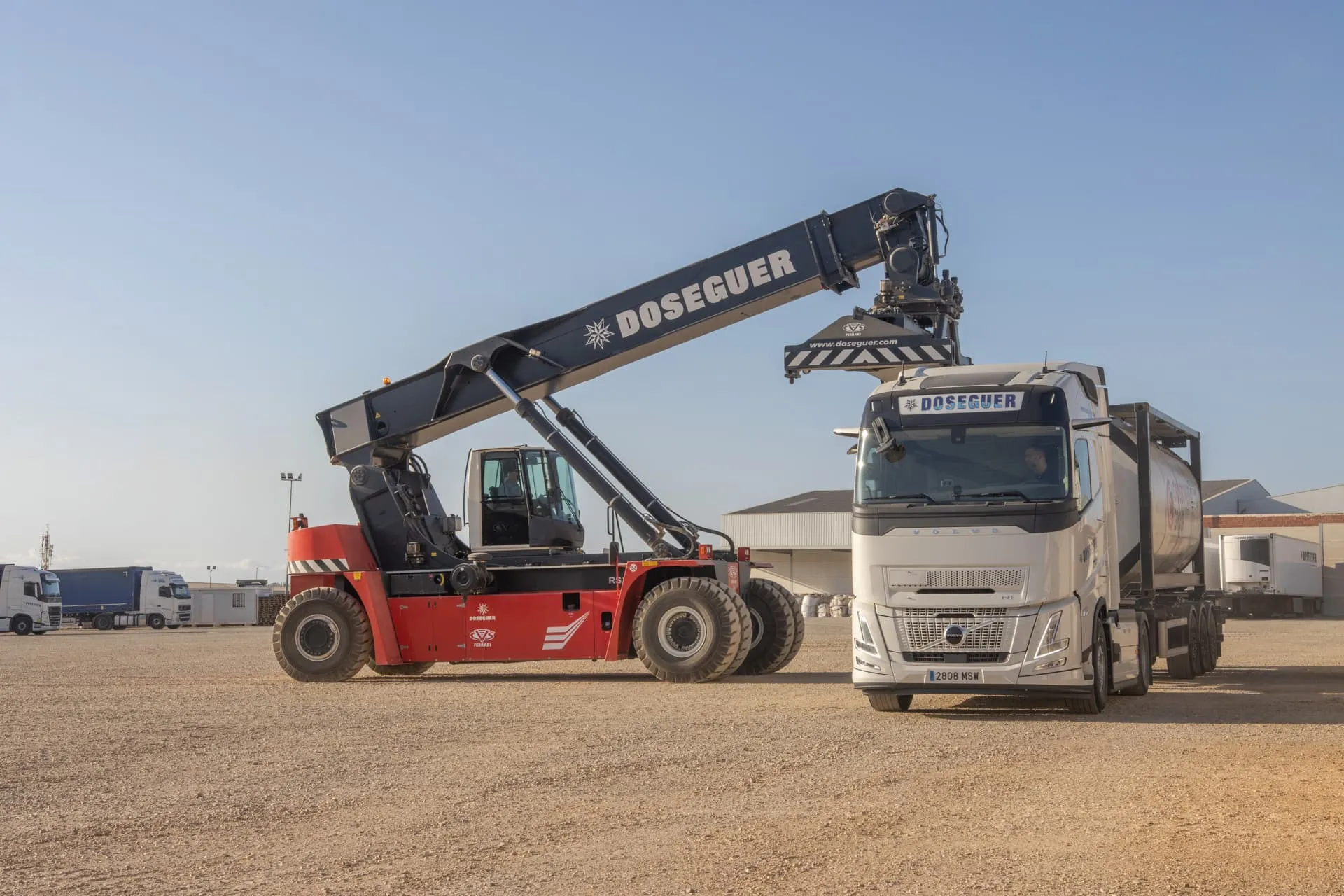
Your container, from the port to its final destination
As part of broadening the ways we move goods, we also offer intermodal transport by container, handling every formality required to collect or deliver your container at the port.
Container transport is an essential link in the global logistics chain: it moves goods efficiently and safely by combining ship, rail and road, without handling the cargo itself at each change of mode.
What is container transport?
It is the movement of goods in standardised containers that can be transferred easily between different modes of transport — ships, trains and lorries. That ability to handle large volumes efficiently and safely is what makes it crucial to international logistics.
Using a standard container brings interoperability and flexibility: it improves supply chain efficiency and cuts operating costs, because the goods travel inside the same box from origin to destination.
Container types we handle
Every cargo calls for its own container. These are the most common types in the sector and what they are used for:
The most common one: suitable for most dry and palletised goods.
For goods that need temperature control throughout the journey.
For cargo that exceeds the dimensions of a closed container.
For goods that cannot easily be loaded through the rear doors.
For bulk liquids, with the handling protocols they require.
Greater internal height for bulky cargo that is light for its volume.
For products that need air circulation during transport.
For bulk products such as grain or minerals.
Security and protection of the cargo
The container itself provides a high level of protection, reducing the risk of damage and theft. That matters most with high-value or sensitive goods — electronics, perishable food or hazardous materials — which demand careful handling and specific conditions.
On top of that protection we add our own equipment and technology. Extendable and tipping platforms allow containers of different sizes to be loaded and unloaded safely, and fleet management software lets us plan routes, track vehicles in real time and resolve incidents without losing time.
How we protect every container
Why choose Doseguer for your container transport?
We take care of the whole process of collecting and delivering your container at the terminal.
Transferring between modes of transport cuts handling times and costs.
Extendable and tipping platforms for containers of different sizes and types.
Seals, monitoring and specific protocols for high-value or sensitive goods.
A single point of contact for the whole journey, with real-time tracking of every movement.
Lower CO₂ emissions through cleaner fuels, and compliance with environmental regulations.
Our container fleet
Tractor units and platforms prepared for sea containers, with loading and unloading equipment adapted to each type and size.
Container transport across Spain
We operate from Almería with connections to the main ports and logistics platforms. Ask us about the options for each destination.
Frequently asked questions
How much does it cost to transport a container?
It varies considerably with the distance, the type of container, the mode of transport — sea, rail or road — and any additional services such as insurance or handling. As an order of magnitude, a standard container on an international journey usually falls between €1,000 and €5,000. Write to us with no obligation and we will give you a precise quote.
How are containers transported?
By sea, loaded onto container ships; by rail, on wagons from intermodal terminals; and by road, on lorries designed for the purpose. Most shipments combine several of these methods — that is what intermodal transport means, and it is what brings flexibility and efficiency to the supply chain.
How does container transport work?
The container is loaded at origin, secured and sealed. From there it travels to the nearest port or terminal, where it is loaded onto a ship, train or lorry as required, and it may change mode at several intermodal terminals before reaching its destination, where it is unloaded and delivered. How smoothly this runs depends on coordination between operators and on the logistics infrastructure available.