
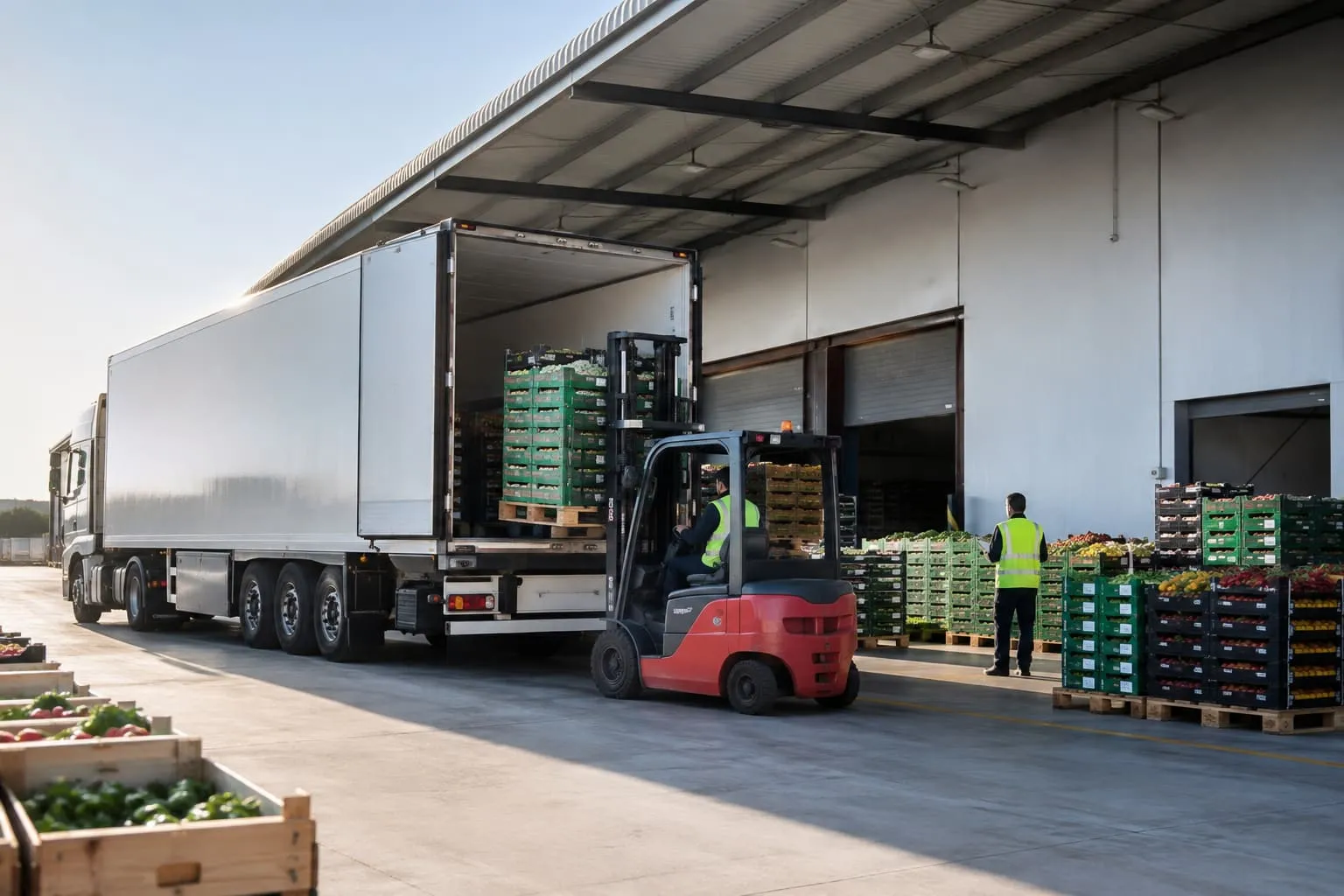
Produce that arrives as it left the field
Transporting fruit and vegetables is a process that is crucial for these products to reach their destination in optimal condition. At Doseguer we are specialists in this sector, with long experience and a track record behind us. If you have any questions, get in touch — we will be glad to answer them.
The fresh produce sector is vital to the economy: as well as being essential to food supply, it accounts for a large share of agricultural exports. Proper transport is what ensures produce arrives fresh and stays competitive in the market.
Moving perishable food brings its own challenges — holding a constant temperature, avoiding physical damage — but it also opens the door to innovation: temperature sensors and real-time traceability systems that did not exist before.
Every fruit and vegetable has its own needs
Not all produce behaves the same way. Climacteric fruit and vegetables carry on ripening after harvest, while non-climacteric ones stop as soon as they are picked. It is a factor that shapes the planning of every shipment.
Each product also has its optimal storage temperature: citrus keeps best between 8 and 10 ºC, while broccoli calls for around 2 ºC. Matching the vehicle to that range is the difference between produce that arrives just right and produce that arrives past its best.
Alongside temperature comes humidity: controlling it is what prevents dehydration and deterioration along the way.
Vehicles adapted to perishable goods
Depending on what the cargo demands, produce travels in one type of vehicle or another:
Insulated walls that limit heat exchange between inside and outside, keeping the temperature constant.
Adds to that insulation a cooling system that brings the internal temperature down and holds it there.
An insulated vehicle designed to generate heat and hold a constant temperature, ideal for produce that must not get too cold.
Covers the whole range, which makes it possible to carry a wide variety of perishable goods.
ATP regulations and the cold chain
In Spain, the transport of fruit and vegetables is governed by Royal Decree 1202/05 and by the Agreement on the International Carriage of Perishable Foodstuffs (ATP), which set the conditions to be met to guarantee the quality and safety of produce throughout the process.
Vehicles must meet specific technical requirements — insulated walls and temperature control systems — and carry the ATP identification plate certifying their suitability for perishable goods.
On that foundation rests the cold chain, the temperature control that keeps produce in optimal condition from origin to destination. Breaking it is costly: loss of freshness, shorter shelf life and a food safety risk.
What we watch on every shipment
Why choose Doseguer for your fresh produce?
Years moving fresh produce, and the knowledge that brings about each season and each destination.
Vehicles with ATP plates and cooling equipment matched to the range each product needs.
Continuous control of both, which is what prevents dehydration and deterioration.
Sensors and real-time tracking, so the conditions the cargo travels in are known at all times.
Route design and control to cut journey time, the greatest enemy of fresh produce.
The right techniques and equipment when loading and unloading, to avoid physical damage to the goods.
Our fleet for fresh produce
Insulated, refrigerated and mechanically cooled ATP-approved vehicles, with capacity for full, part and consolidated loads.
Fruit and vegetable transport across Spain
We operate from Almería with regular routes to the main growing areas. Ask us about the options for each destination.
Frequently asked questions
How are fruit and vegetables transported?
Mainly in refrigerated lorries, also known as reefer trucks, which hold the right temperature and keep produce fresh during the journey. They are fitted with systems that control temperature and humidity so the goods do not deteriorate. For large volumes travelling by sea or air, refrigerated containers are used as well.
What should packaging for transporting fruit be like?
It has to protect the produce during transport and storage. The usual options are cardboard boxes, plastic crates, corrugated board, trays or palletainers, always with proper ventilation; padding materials and internal dividers help prevent physical damage. It should resist humidity and temperature swings. The choice depends on the type of product, the distance and the ambient conditions of the journey.
What are the lorries that carry fruit called?
Refrigerated lorries, or reefer trucks. They are vehicles designed to hold a controlled temperature while carrying perishable goods, so that they arrive at their destination in optimal condition.
How do fruit and vegetables reach the supermarket?
Through an organised supply chain: produce is harvested in the field and prepared at packing facilities, loaded onto refrigerated lorries that take it to distribution centres, and from there distributed to each supermarket — in smaller vehicles or in the same refrigerated lorries — where it is unloaded and placed on the shelves.